



.png)

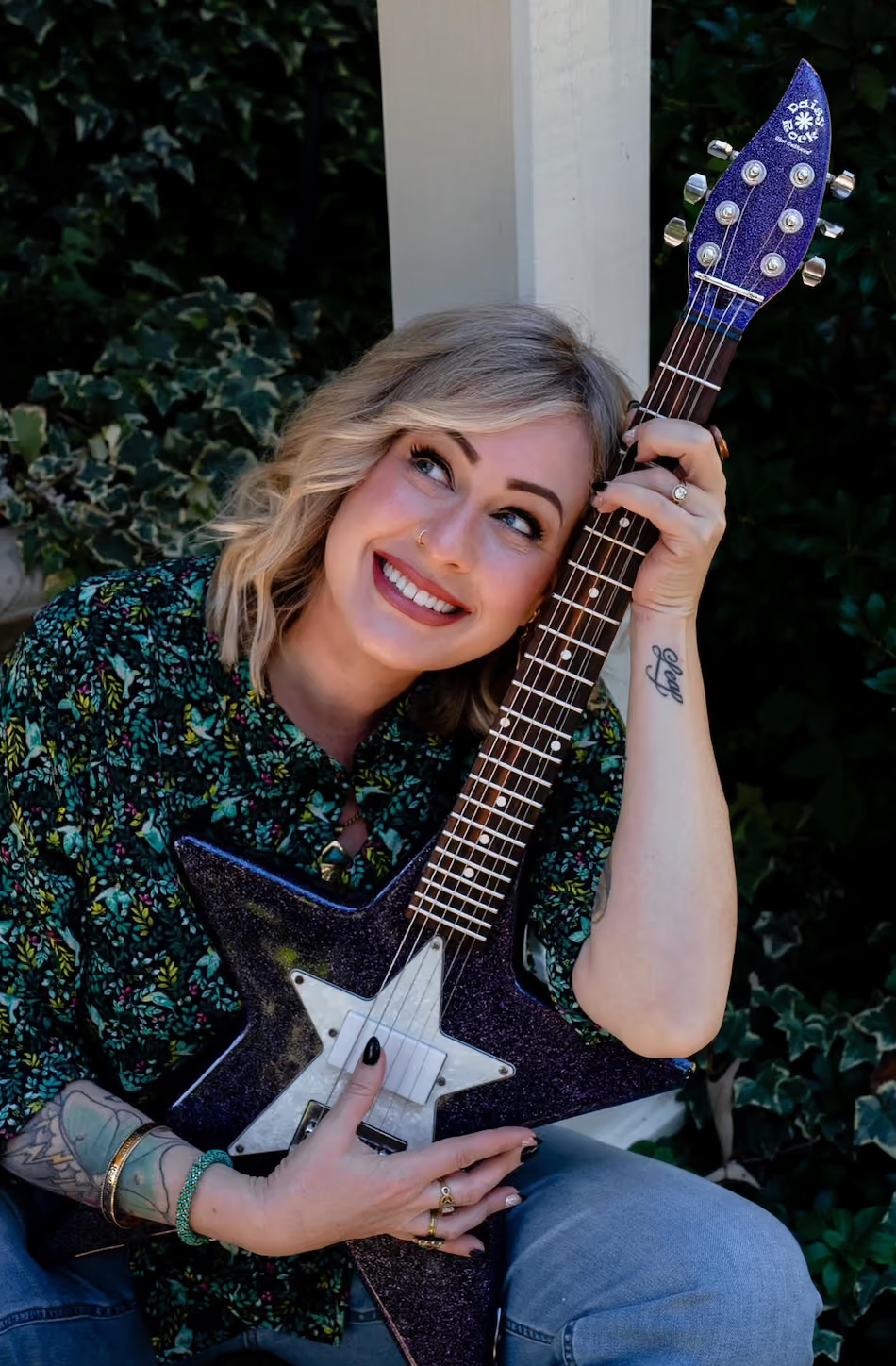
Nikolai Blinow, LMHC, is a burnout specialist and therapist who helps high-achieving neurodivergent women stop living in survival mode. A late-diagnosed ADHD woman herself, Nikolai draws on lived experience alongside clinical tools like DBT (Dialectical Behavioral Therapy) and EMDR (Eye Movement Desensitization and Reprocessing) to support women in reclaiming their energy, identity, and joy. In this interview, she shares her journey to diagnosis, the power of radical acceptance, and why she believes neurodivergence is a strength — not a deficit.
Get to know Nikolai
Briefly tell us about yourself.
I'm a first-generation American on my Dad's side. He is an immigrant from Eastern Europe. First generation college student on both sides of my family. I am a therapist who changed careers pretty early on, as my upbringing taught me to value stability and a good corporate job with great benefits, but I quickly realized that doing work I was passionate about, and working on my own terms, was what mattered most. So I left my first career in Institutional Advancement (aka fundraising), to pursue my licensure in mental health counseling. I'm also a late-in-life diagnosed ADHD woman (which probably explains why my first career, which was more of a "desk job", didn't light me up). Now, I'm passionate about helping other high-achieving women, especially fellow neurodivergent women, stop living in survival mode through a combination of DBT, EMDR, and coaching. I also just love walking my two labrador retrievers along the ocean. It's so healing.
When did you first realize you might be neurodivergent?
Strangely enough, I developed a bit of a superpower for diagnosing the high-functioning, high-performing neurodivergent clients who had slipped through the cracks for many years, without realizing that I was neurodivergent myself! I've worked in the field of burnout for many years, and often would see burnt-out ADHD (Attention Deficit Hyperactivity Disorder) and AuDHD (ADHD + autism) clients who were burnt out because of years of masking and not even realizing they were neurodivergent. As I started speaking to my therapist friends, they began saying "You know, I think you are neurodivergent too." I got licensed as a therapist around age 30, but I didn't get formally diagnosed with ADHD until I was almost 40.
What was your journey to diagnosis like? How did you feel when you received it?
Honestly, I feel like I fought it for a bit, because I had some internalized stereotypes about ADHD, even as a therapist. The outdated, gendered criteria causes us to envision an ADHD person as "chaotic," "all-over-the-place" or "disorganized," and I viewed myself as quite the opposite. I achieved my professional goals fairly early in life, did things that friends and colleagues told me were "hard", and had a good reputation in my professional community as a therapist who was not just good clinically, but good at running an organized business. In fact, I am often the person other therapists come to for business guidance and advice. So I thought, "No way can I have ADHD, I am so on top of my shit!" But I also knew I had an internal restlessness that never quit, struggled with slowing down, and sometimes was my own worst enemy when it came to overloading my plate. Oh, and I definitely am NOT organized and timely with things I don't care about. Ask me to mail a non-time sensitive letter, and I will carry that sh*t around in my purse for months. When I got my own diagnosis, and let go of the stereotypes, I actually just went "Yup, this makes sense." And I think I actually feel proud of being neurodivergent. Whereas so many people out there speak about the struggles of being neurodivergent in a neurotypical world, I also feel like it's an amazing strength.
How did your diagnosis impact your life and work?
I started giving myself more permission to work in the ways that felt good to me, not in the ways I thought I "should." For example, I work 3 long client days, have one full day for admin and life, and one day where I do admin in the morning and see clients in the afternoon. To some people, it would seem insane to not have 5 days of a predictable work schedule and workflow, but I've found this is the best way to leverage my mental energy and minimize task-switching in my brain (which is the arch-nemesis of ADHD brains).
What does a typical day look like for you as a burnout specialist?
I know as a clinician specializing in burnout and working with many neurodivergent women, that routine and schedule is so important, but that I also need to be flexible. So, I strive to have a routine that blends both non-negotiables and flexibility.
Every day, I wake up around 6:00 am and make it a point to meditate, get outside, eat a nourishing breakfast, and move my body. Those are my non-negotiables. But sometimes the way those look, or the order I do them in, change based on what else is on my plate at any given point.
After the weekend, I like to ease into my work-week, so I schedule Mondays and Tuesday mornings for administrative work. This helps me ramp up for the week, and also makes sure I take care of the "boring" business tasks when I have the most energy. Tuesday afternoons I start seeing clients for the week, and then Wednesdays through Fridays I focus almost all of my time on client work. I like keeping my administrative brain and my clinical/client brain separate, as these utilize different parts of myself.
Neurodivergence as strength
What are some of your unique strengths that you attribute to being neurodivergent?
I'm so good at seeing patterns in people that they don't see in themselves, and helping people uncover when these patterns initially developed, so that we can untangle them. I've also been told that I'm great at "reading me to filth in a good way" — meaning, I can call my clients out on their sh*t without making them feel ashamed or judged. I think one of the most important things I can do as a therapist and coach is point out where people are getting in their own way. I'd rather point something out and push you to new places, than pump you up and keep you stuck.
What challenges do you or your clients face that others might not immediately understand?
My clients are super high-achieving and do a good job holding it together, so I don't think the rest of the world always sees their neurodiversity, stress, and anxiety. And they often unintentionally internalize beliefs like "I have to be perfect" or "I have to be in control" that often stem from being neurodivergent and having years of coping through masking and achieving.
How do you navigate environments that weren't designed with neurodivergent people in mind?
I teach a lot of radical acceptance, which means accepting situations AND how you feel about them. Most environments aren't intentionally designed to cause harm, but sometimes they do. If we can start with accepting the environment as it is, and the fact that it's not working for us, then we can start to think about what we can problem-solve.
How has being neurodivergent affected your relationships?
As a therapist who works with people for a living, I have to be very mindful of my social battery. My friends and family know that Friday nights are NOT the time to try and make plans with me, as I often need that time to re-charge and rest. And they also know that I'll probably never respond to a text message (ADHD brain). I think my neurotype makes me the person my friends and family come to when they need authenticity or have a problem they want support working-through, but they also know that I may ghost you unintentionally.
Have you found community with other neurodivergent people?
I think a lot of us find each other organically, once we start speaking authentically about who we are and how we experience the world. It's so fun and validating to me, when I can send a fellow neurodivergent entrepreneur an Instagram reel about how choosing the right fork is a genuinely important task in my day. And to hear other women reflect back "Girl, same!" while they are also running badass businesses, being amazing people, and overall just being inspiring in life.
Do you tell people you are neurodivergent? Why or why not?
I do and I don't. I feel like I am so definitely ADHD, but I also feel like that's not all of who I am. Just like being Russian-German and having a parent who is an immigrant is a big part of my experience and identity. I share when it feels relevant or like it's a like-minded space, but I don't share with everyone. Not because I'm ashamed, but because I don't think it's always relevant.
A neurodivergent therapist's approach to self-care
How do you handle difficult days or times when you're struggling?
I make sure to take space for what I'm feeling, rather than push through, and always check in with my Wise Mind. That means balancing what my emotional self needs with what my rational self knows makes sense. When I do this, I can often find a balanced approach through navigating my hard days. For example: I just got back from a very long trip away, and I'm honestly a little sad to be back, because the weather was beautiful and it's still wintertime here in New England. So I'm letting myself feel a little sad, while still staying on top of tasks that I know will make me feel accomplished and grounded at home. Today, my Wise Mind is telling me "do one load of laundry today, not five."
What tools, strategies, or accommodations have been most helpful for your ADHD?
Please schedule time for breaks into your day and your week! I can't tell you how many of my clients overfill their calendars and don't leave time for rest. On my client days, I literally give myself a 2-hour lunch break — part for actual lunch, part for resting my brain, and part proactive planning for little administrative or life-tasks that might creep up unexpectedly. Also: get outside, freaking eat good food (too many of us with ADHD are meal-skippers, and there is so much data on your mental health and your gut health being linked), move your body in some way, and don't be afraid of medicine.
You gave an incredible TEDx talk on yoga. Why is yoga so valuable for neurodivergent individuals?
I have a hypothesis based on my lived experience as a neurodivergent woman and years of working with fellow neurodivergent people — I believe most of us are either kinesthetic learners, and then visual learners. That means that our mind and bodies actually digest information and make sense of it when we DO a task, rather than just listen about a topic or read about it. For me, yoga is a way to DO the work of slowing down, of understanding what feels good in your body and what doesn't, and to literally observe how your mind responds to stress. When we do this practice, we learn valuable information about ourselves and how we react to stress, that we can then take out into our lives.
How do you teach your clients to advocate for themselves?
Lots of DBT skills, coaching, and practice!
What advice would you give to someone who's experiencing burnout?
Face your fears about slowing down and learn what may unintentionally be keeping you stuck in hustle-mode. If you struggle with doing this on your own, get support. If peer support or mentorship isn't enough, or not an option, get a therapist or well-trained coach to help you. It will save you a lot of time, energy, and stress in the long term.
Understanding neurodivergence from a therapist's perspective
What misconceptions about neurodivergence do you encounter most often?
That neurodivergent people are disorganized and chaotic, or that there's "something wrong" with being neurodivergent. Just because 90% of the population is neurotypical, doesn't mean there is anything wrong with you. In fact, I would argue that your neurodivergence actually makes you more valuable, and you serve an important need in our community and social structure.
If you could change one thing about how society views neurodivergence, what would it be?
I would change that it's considered a disability or something "bad" that you have to "learn to manage." Neurodivergent is just who we are, and it makes us awesome. Oh, and also that now "everyone" is neurodivergent and we are either just faking it or "too sensitive." That's not true. More people are being identified as neurodivergent because our understanding of neurodivergency is changing, and we are becoming more informed. And while we can be sensitive people, that's also a great strength.
What advice would you give to people who want to be more supportive of a neurodivergent person in their life?
Learn how to validate. People are so afraid of validating a person's experience, when really, it's one of the best things you can do to strengthen relationships and make collaboration possible. And know that you only have to validate what's valid. So, for example, if I'm anxious and procrastinating, you can validate my stress and anxiety without validating the fact that I'm procrastinating.
What are your hopes for the future regarding neurodivergent acceptance and understanding?
Honestly, I just want more amazing neurodivergent women to feel proud and accomplished. Too often, I see amazing, really successful women with ADHD or AuDHD who feel like "I'm too much," or "There's something wrong with me," or "I'm all alone in this" and it sucks. Instead, I want neurodivergent women to genuinely believe "I'm okay as I am, regardless" (of what other people think, or what happens), "I can only control what I can," and "I can survive and thrive."
.svg)


